

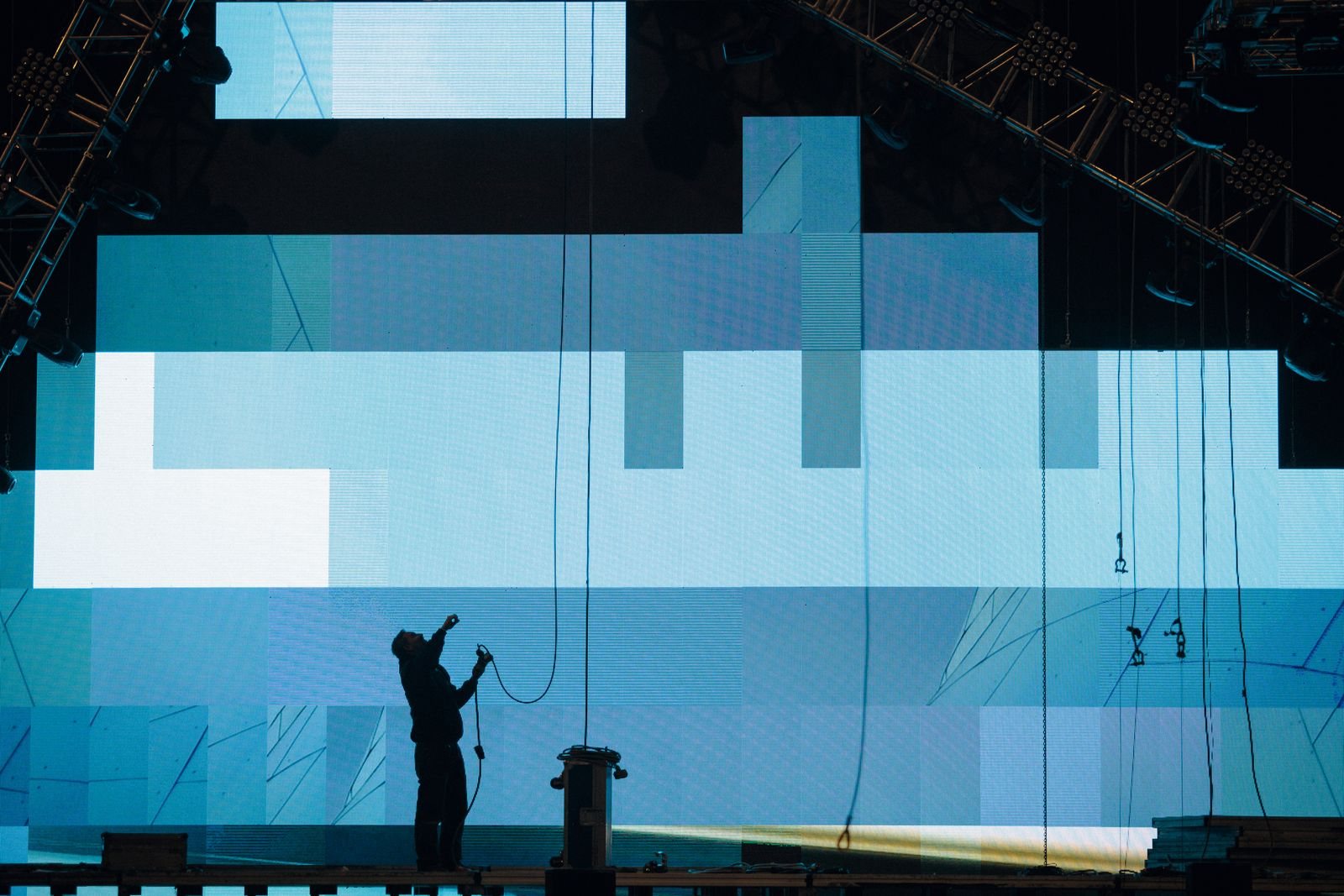
If you've been to a conference lately, you've probably seen a giant LED wall behind the stage and thought, "We need one of those." Maybe you do. Maybe you don't. Here's how we walk clients through it.
How they're different
Projection is what most people grew up with. A projector throws an image onto a screen, either from the front (out in the room) or from behind (rear projection). It's been around forever, it's well understood and it can look great.
An LED wall is built from panels covered in tiny light-emitting diodes. There's no projector and no screen. The wall itself makes the light. You build it like a big set of building blocks, so it can be just about any size or shape the room and the rigging allow.
Light is usually the deciding factor
Projection hates ambient light. If your room has windows, a lot of house lights, or an event that needs the audience lit so people can take notes, a projected image can start to look washed out. You end up fighting the room.
LED walls are bright. Really bright. They hold up in rooms with daylight, under stage lighting and even outdoors. In a lot of cases we actually turn them down.
The room matters too
Front projection needs a clear path from the projector to the screen. That means a projector out in the audience area or hung from the ceiling, and nobody walking through the beam. Rear projection needs real estate behind the screen, sometimes a lot of it, which eats into your room.
LED needs none of that throw distance. It does need power, a solid structure to stand on or hang from and enough time on load-in to build it. Ceiling height and rigging points matter for both.
What's pixel pitch?
When you look into LED, you'll hear "pixel pitch." It's the distance between the little lights, measured in millimeters. A smaller pitch means the pixels are closer together and the image holds up when people are sitting close. A larger pitch is fine when the audience is farther back. Get it wrong and the front row sees a screen door instead of your logo. We'll match the pitch to your room so you aren't paying for detail nobody can see.
So which one?
Here's our rough breakdown:
Projection often makes sense for darker rooms, simpler setups, breakouts and shows where the screen just needs to show slides clearly.
LED often makes sense for rooms with ambient light, big general sessions, shows where the screen is part of the set design and anywhere you want that bright, seamless look on camera.
Plenty of shows use both. LED behind the main stage, projection in the breakouts. There's no rule that says you have to pick one for the whole event.
A word on content
Whatever you choose, build your content for the screen you're actually getting. Wide LED walls often aren't 16:9, so a standard slide may need to sit inside a custom design. Ask your production team for the exact canvas size early. Finding out the night before that your video is the wrong shape is nobody's idea of fun.
If you're not sure which way to go, tell us about the room and what you want people to walk away with. We'll tell you honestly what fits, even if that's the simpler option.